Counting down to Gaia DR4
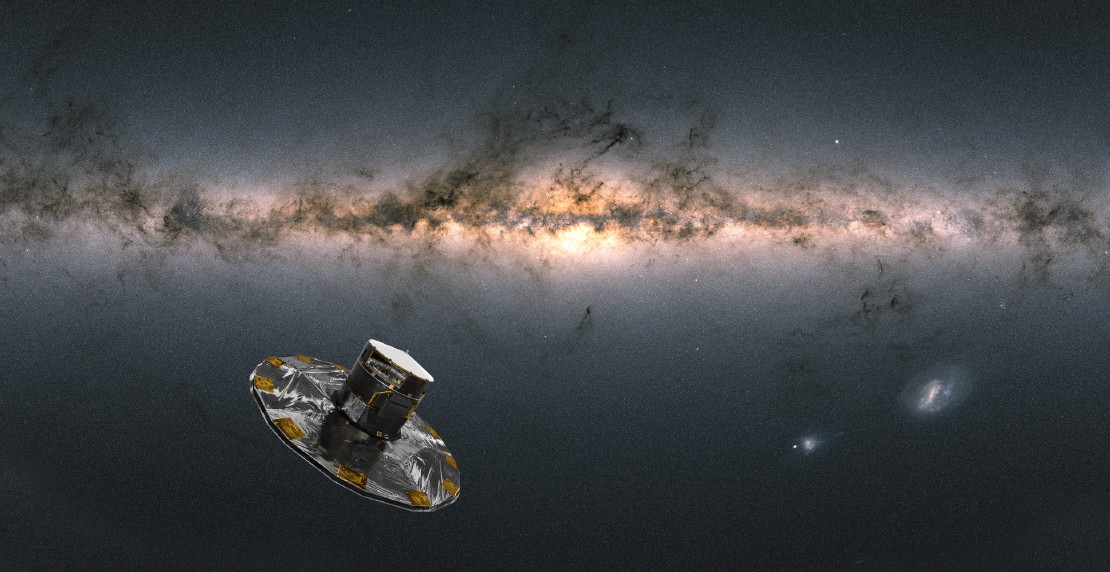
The European Space Agency’s Gaia Mission is the first astronomical mission to create a detailed survey of the Milky Way galaxy far beyond the immediate boundaries of the Local Bubble. The fourth data release, expected in December 2026, is generating much excitement.
Why is Gaia Data Release 4 so exciting?
Although the Gaia spacecraft, as planned, stopped collecting data in March 2025, most of its data has not yet been analysed or published.
Gaia DR3, released on 13 June 2022, included 34 months of the approximately 126 months of data now collected by the spacecraft. Gaia DR4 will be based on 66 months or about twice as much data. As a result, Gaia DR4 is expected to have much more accurate parameters for about 2 billion stars. This is likely to result in more accurate hot star maps, especially for the inner galaxy, and a much more accurate catalog of star clusters.
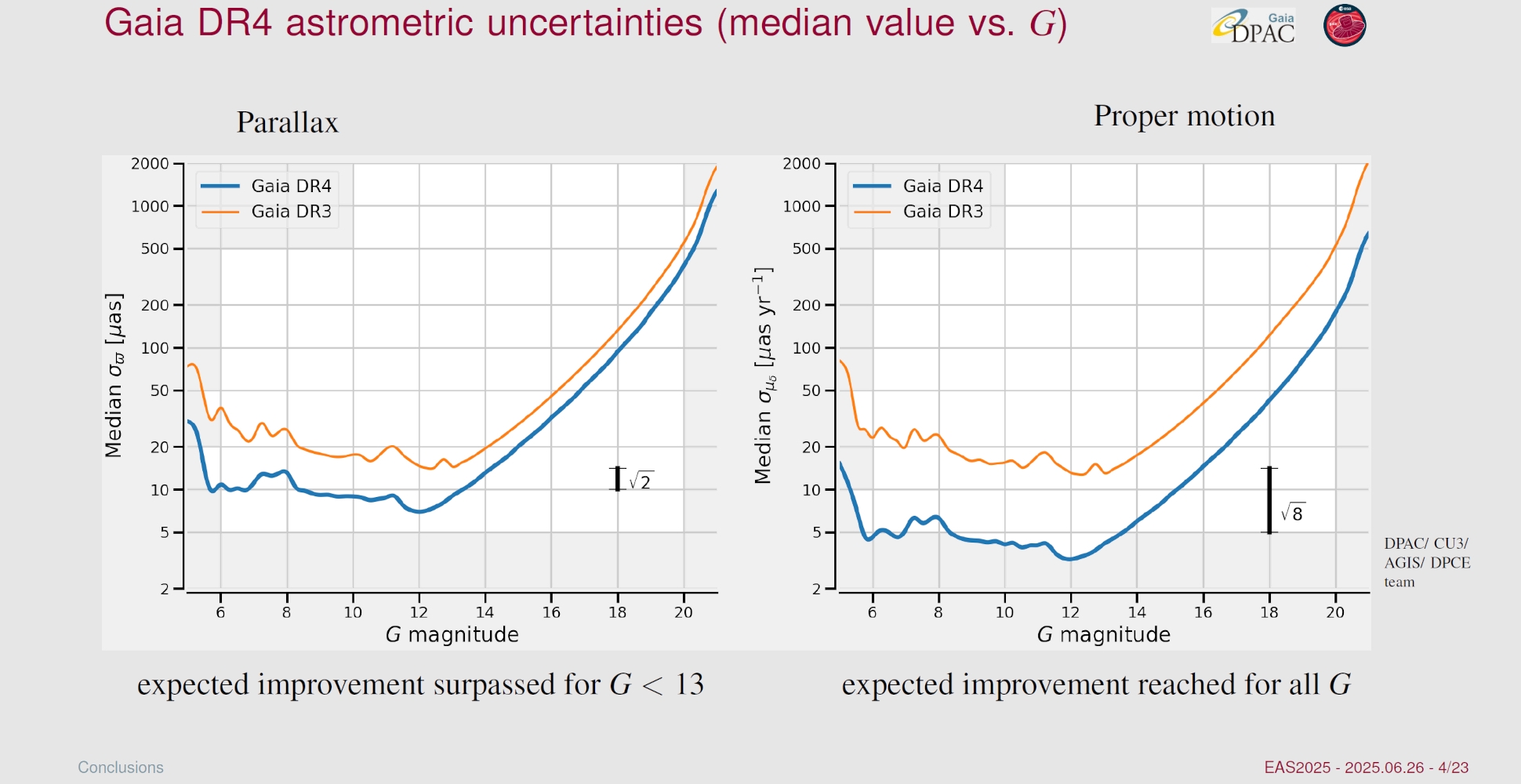
Anthony Brown, the chair of the Gaia Data Processing and Analysis Consortium, released this chart showing the improved accuracy of Gaia DR4 at the meeting of the European Astronomical Society in Cork, Ireland at the end of June 2025.
In short, it shows that for brighter stars, compared to Gaia DR3, parallax errors are about half as much for Gaia DR4, and proper motion errors about a quarter as much. Stunning results.
Exoplanets
The increased accuracy of Gaia DR4 means that it will help considerably in detecting stellar companions by detecting tiny wobbles in stellar movements. This will help detect more secondary stars and brown dwarfs in multiple star systems. It will even help detect more exoplanets.
Astronomers have estimated that the Gaia Mission final data release may enable the detection of an astonishing 70 thousand exoplanets. Gaia astronomers have been cautious about estimating how many of these will be detected by Gaia DR4, suggesting only “thousands”. Since astronomers have so far detected a little over 5000 exoplanets, it seems conceivable that Gaia DR4 could double or even triple the size of this list.
Bright Stars
Gaia has difficulty determining the properties of stars with very high relative magnitudes because they overwhelm its optical detectors. Although this restriction occurs only for a small number of stars, they include many of the famous bright stars observed by amateur astronomers. For this reason, Gaia DR4 includes a small catalog that uses a special technique to attempt to determine parallax and other properties for bright stars, giving some hope that it might provide information on famous stars with highly debated distance estimates including Deneb and Alnilam.
Time Series
Gaia DR3 consists about 10 TB of data. Gaia DR4 will be dramatically larger with about 500 TB of data. To a small extent this is because it will include information on more objects (about 2.7 billion sources including stars and galaxies) but mostly because that data size increase is because Gaia DR4 will include data on individual observations. This may tremendously increase our knowledge of stars with properties that appear to vary in time, including variable stars or those in multiple star systems.
Related Posts
Where is the Gaia data?
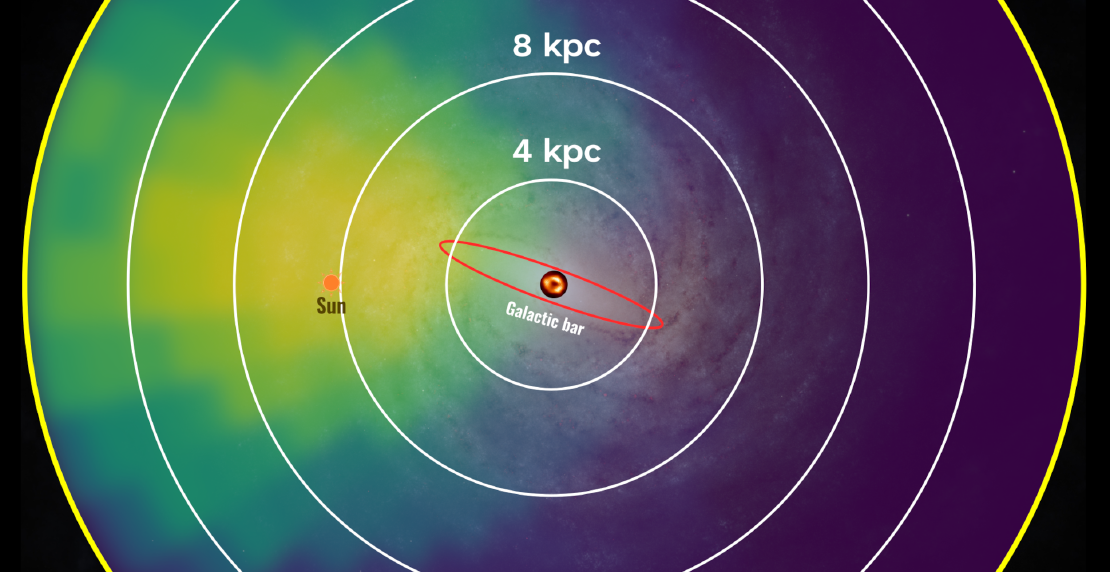
The European Space Agency’s Gaia Mission has provided distance estimates, magnitude, colour and other data for almost 2 billion stars, making it possible to map out the local galaxy in detail for the first time.
Read more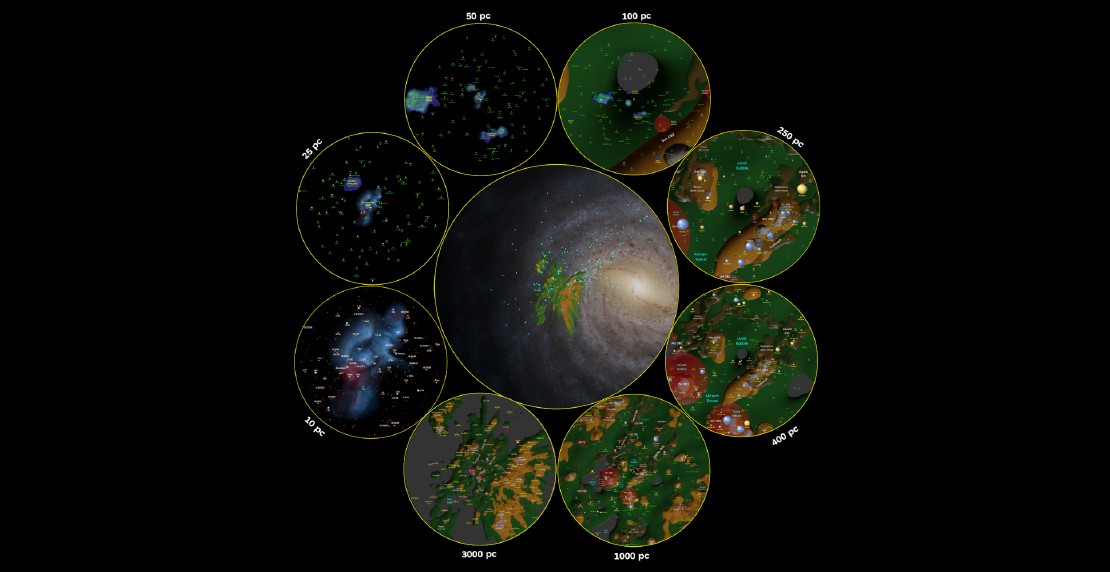

Exploring the Milky Way in VR
Today I’m announcing two experiences in Horizon Worlds that let you explore our home galaxy, the Milky Way. on the web, mobile phones or in virtual reality.
Read more